9 min read
The Rise of Vertical AI Platforms
AI agents are transforming software into digital labor. Learn why vertical AI platforms like SCRUBgpt represent the next wave of industry infrastructure.
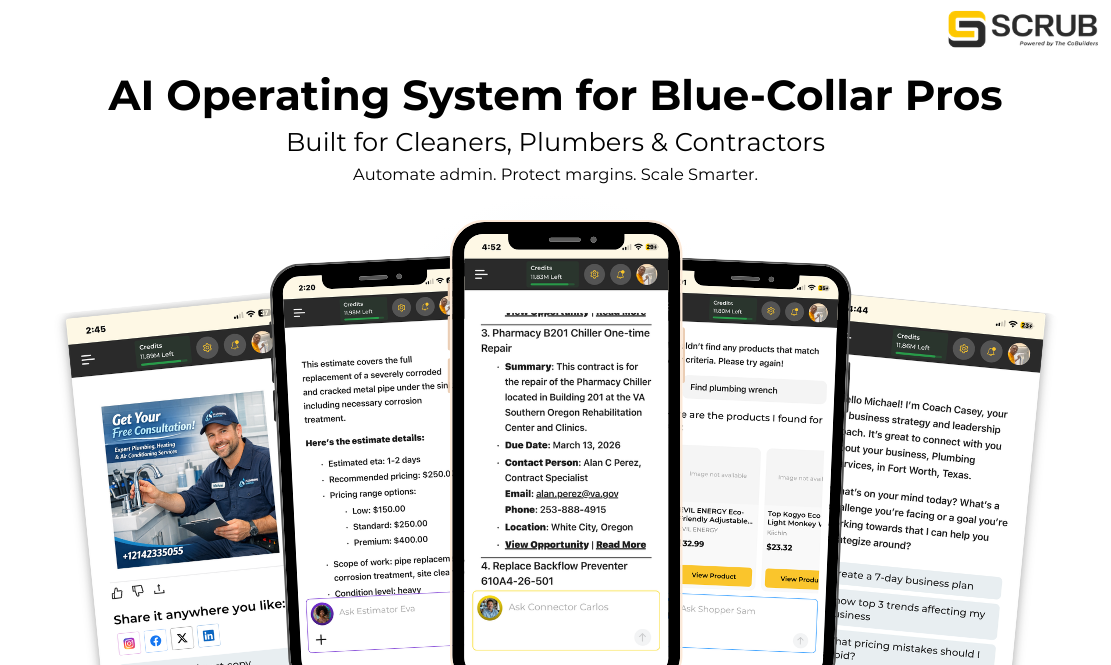
What Is a Vertical AI Platform?
A vertical AI platform is an artificial intelligence system designed for the workflows, terminology, decisions, and operating needs of a particular industry.
Unlike general-purpose AI tools that respond to broad questions, vertical AI platforms help businesses complete industry-specific work.
For a service business, that could include:
Finding customers and contract opportunities
Reviewing job requirements
Creating estimates
Marketing completed projects
Comparing supplies
Following up with customers
Analyzing jobsite photos
Improving profitability
Vertical AI is especially relevant to cleaning companies, plumbers, HVAC contractors, electricians, and other service professionals because these businesses often need support across several operational functions but lack large administrative teams.
The emergence of capable AI agents is accelerating this shift.
Last week, the market reaction to the expansion of AI agents beyond coding was swift.
Reuters summarized the concern across the technology sector: U.S. software stocks experienced significant pressure as investors considered how AI agents could disrupt traditional software businesses.
The concern is understandable.
As AI agents become more capable, many founders and investors are asking:
What happens to traditional software when AI begins performing the work that software was originally designed to support?
Where some see disruption and uncertainty, we see an opportunity—particularly for businesses building deeply integrated vertical AI platforms.
At SCRUBgpt, these changes reinforce why we are building an AI operating system for service businesses.
Vertical AI vs. Horizontal AI
Horizontal AI tools are designed for broad use across many industries. They can write content, summarize documents, answer questions, and support general research. Because they are built for a wide range of users, they often require people to explain their business context, goals, and workflow each time they use them.
Vertical AI platforms are different. They are built around the needs of a specific industry or type of business. Instead of serving many unrelated use cases, they focus on the terminology, decisions, and workflows that matter within a defined market.
Horizontal AI usually provides general answers and produces isolated outputs. Vertical AI is designed to support specialized workflows, connect related tasks, and apply industry knowledge to real business decisions. While horizontal AI often focuses on conversation, vertical AI focuses more directly on helping users complete work.
Both forms of AI can be valuable. The key difference is that vertical AI is designed to move from information to action within a particular business environment.
1. AI Is Becoming Digital Labor
The first major shift is conceptual.
AI is no longer just a productivity tool.
It is increasingly becoming digital labor.
Instead of software helping humans perform tasks faster, AI agents are beginning to perform entire workflows on behalf of users.
This changes the value proposition dramatically.
The future of software is not simply dashboards and interfaces.
It is systems that can perform work.
For service industries such as cleaning, plumbing, construction, and HVAC services, this is particularly powerful because many operators lack the infrastructure to support complex business operations.
AI agents can act as digital assistants embedded directly into the workflow of a business.
2. SaaS Defensibility Shifts From Interface to Workflow and Data
Traditional SaaS companies often built defensibility around their interface and feature set.
But when AI can replicate interfaces quickly, defensibility moves elsewhere.
The strongest businesses will be those that control:
• Workflow integration
• Proprietary data and feedback loops
• Operational infrastructure embedded in the customer’s daily work
This is why vertical platforms built around specific industries and workflows will have an advantage.
In the case of SCRUBgpt, our focus is not simply providing AI chat functionality.
Our goal is to integrate AI directly into the operational workflows of blue-collar service businesses.
3. Verticalization Will Accelerate
Horizontal AI tools can serve many industries.
But the most valuable AI companies will likely be deeply verticalized.
Every industry has unique workflows, regulations, pricing structures, and operational dynamics.
The needs of a software developer are very different from the needs of a plumber, janitorial contractor, or HVAC technician.
Vertical AI platforms that deeply understand an industry can deliver significantly more value than generic tools.
SCRUBgpt focuses on the blue-collar service economy, a sector that includes millions of businesses responsible for maintaining homes, buildings, and infrastructure.
Despite its size, this sector remains largely underserved by modern AI tools.
Examples of Vertical AI for Service Businesses
Vertical AI becomes most valuable when it is connected to the work a business performs every day.
Vertical AI for Cleaning Businesses
A cleaning company could use vertical AI to review a new scope of work, estimate labor requirements, identify government or commercial opportunities, compare supplies, and turn completed jobs into marketing content. Cleaning business software powered by AI can generate more business value than an horizontal solution.
Vertical AI for Plumbing Companies
A plumber could use AI to analyze customer photos, prepare an initial scope, create a pricing estimate, identify replacement parts, follow up on an unanswered quote, and promote the completed project. AI for plumbers can help small business owners find more work and make better decisions.
Vertical AI for HVAC Companies
An HVAC business could use vertical AI to support estimating, seasonal marketing, commercial prospecting, equipment research, maintenance-agreement follow-up, and profitability analysis.
Vertical AI for Electrical Contractors
An electrical company could use AI to organize project requirements, draft estimates, research supplies, prepare customer communications, and identify new commercial or government work.
Vertical AI for General Contractors
A contractor could use industry-specific AI to analyze project information, prepare proposals, evaluate pricing assumptions, identify subcontracting opportunities, and coordinate connected business workflows. AI estimating software for contractors will greatly reduce cost while significantly increase margins.
These examples illustrate why vertical AI platforms can create more value than isolated AI tools. They are designed around the sequence of decisions required to move work forward.
4. Enterprise Buying Will Shift to Line-of-Business Budgets
Historically, enterprise software purchasing decisions were controlled by IT departments.
AI is changing this dynamic.
When software performs operational work, the value becomes clear to line-of-business leaders who directly benefit from improved productivity and decision-making.
This means buying decisions will increasingly shift toward:
• Operations leaders
• Business owners
• Department heads
For SCRUBgpt, this aligns directly with our target users.
Our platform is designed for operators and service business owners, not just technical teams.
5. A New Infrastructure Layer Is Emerging
As AI agents become more capable, a new infrastructure layer becomes necessary.
This layer will manage:
• Multi-agent orchestration
• Workflow automation
• Data integration
• Decision support systems
Platforms that successfully integrate these capabilities into a cohesive system will become foundational to how businesses operate.
SCRUBgpt is being developed as part of this emerging infrastructure layer — specifically for the service economy.
6. Distribution Becomes the New Moat
In an AI-driven world, technology itself becomes easier to replicate.
What becomes harder to replicate is distribution.
Companies that control strong distribution channels and customer relationships will maintain significant advantages.
Owning the customer relationship means understanding the real problems users face and embedding solutions into their daily workflows.
For SCRUBgpt, this means focusing on the service professionals who power the physical economy:
• Cleaners
• Plumbers
• Electricians
• HVAC technicians
• Contractors
• Property service providers
These professionals represent one of the largest segments of the global workforce — yet historically have had limited access to advanced digital tools.
SCRUBgpt as a Vertical AI Platform
SCRUBgpt is being built as a vertical AI operating system for service businesses.
Instead of offering one general-purpose chatbot, SCRUBgpt brings together specialized AI business assistants that support different parts of a company's workflow.
These assistants can help service businesses:
Identify prospective customers and contract opportunities
Evaluate project requirements
Develop estimates and pricing recommendations
Create marketing content
Compare supplies and purchasing options
Analyze financial performance
Review jobsite photos and videos
Automate reminders and follow-up activities
Receive practical business guidance
The objective is not simply to provide more AI-generated answers.
It is to help a business move from insight to action and from one business task to the next without repeatedly restarting the process.
That connected workflow is what separates a vertical AI operating system from a collection of disconnected AI tools.
Threat or Opportunity?
The rise of AI agents capable of performing complex tasks will disrupt many existing software categories.
But disruption creates opportunity for companies building deep, vertically integrated systems.
Shallow tools will struggle.
Platforms that integrate deeply into real workflows will thrive.
For SCRUBgpt, the direction is clear.
We are building an AI operating system for the blue-collar economy — a system designed to help service businesses find opportunities, automate operations, make better decisions, and grow more efficiently.
Looking Ahead
The expansion of AI agents beyond coding marks an important moment in the evolution of digital infrastructure.
For investors and partners evaluating opportunities in the AI ecosystem, one trend is becoming increasingly clear:
The next generation of AI companies will not simply build tools.
They will build operating systems for industries.
SCRUBgpt is focused on doing exactly that for the service economy.
Frequently Asked Questions About Vertical AI
What is vertical AI?
Vertical AI is artificial intelligence designed for the terminology, workflows, data, regulations, and decisions of a particular industry. It differs from general-purpose AI because it is built to support specialized business activities.
What is a vertical AI platform?
A vertical AI platform combines industry-specific intelligence with workflows, automation, data, and decision support. Its purpose is to help users complete work within a defined industry rather than simply answer general questions.
What are examples of vertical AI?
Examples include AI platforms designed for healthcare, legal services, finance, construction, manufacturing, cleaning, plumbing, HVAC, electrical work, and other service industries.
How is vertical AI different from vertical SaaS?
Vertical SaaS primarily provides software features for a specific industry. Vertical AI goes further by helping perform tasks, generate recommendations, automate decisions, and coordinate workflows within that industry.
Why is vertical AI important for small businesses?
Small businesses often lack large administrative, marketing, sales, and analytics teams. Vertical AI can provide specialized support across these functions without requiring the business to adopt numerous disconnected tools.
Can vertical AI replace workers?
Vertical AI is generally most valuable when it supports workers rather than replacing them. For service businesses, AI can reduce administrative work, improve decision-making, and allow skilled professionals to spend more time serving customers.
Ready to get started?
Ready to run your service business with AI?
SCRUBgpt helps blue-collar professionals find commercial leads, automate operations, improve marketing visibility, and run their businesses more efficiently.
Try SCRUBgpt free for 7 days and see how AI can support your business.


Featured Posts
1 min read
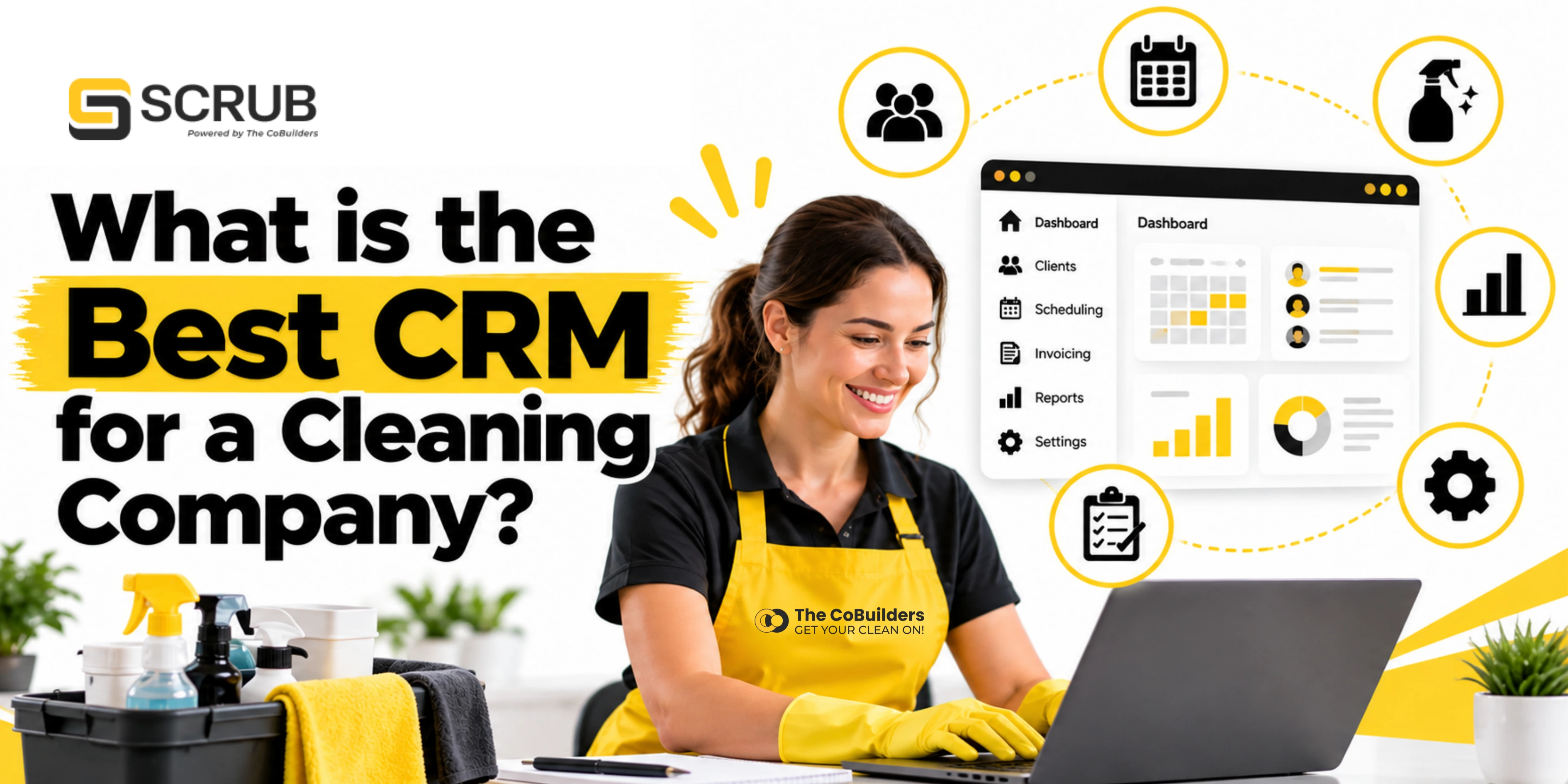
What is the Best CRM for a Cleaning Company?
1 min read
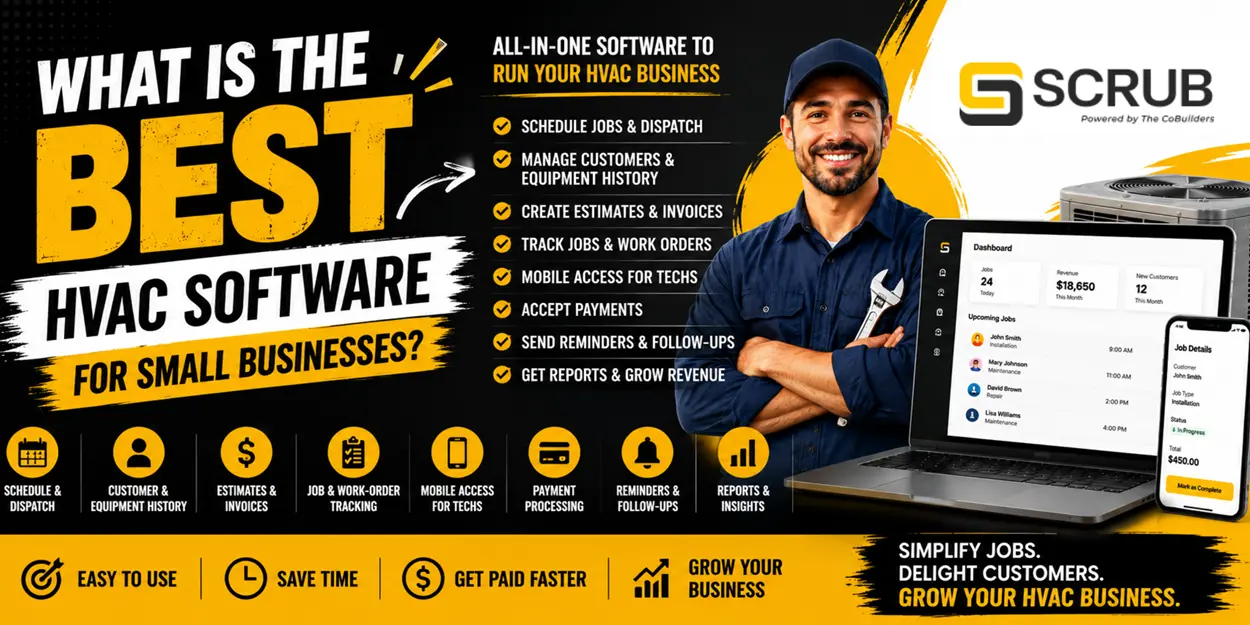
What is the Best HVAC Software for Small Businesses?
1 min read
What is the Best Estimating Software for Plumbing Jobs?
1 min read
SCRUBgpt Is Now Available on AWS Marketplace
1 min read
Can Plumbing Business Software Help You Grow Faster?
1 min read
AI Tools for Small Business: 9 Ways to Save Time and Grow
Related Blog
1 min read
What is the Best CRM for a Cleaning Company?
This guide covers what a CRM for a cleaning company should include, why generic CRMs often fall short, and which features matter most as your business grows.
1 min read
What is the Best HVAC Software for Small Businesses?
Running a small HVAC business means juggling scheduling, invoicing, and customer records all at once. This guide breaks down what to look for in HVAC software — and how to pick the right fit for your team.
1 min read
What is the Best Estimating Software for Plumbing Jobs?
Explore the best plumbing estimating software, key features, AI tools, pricing options, and tips to choose the right solution for your plumbing business.
1 min read
SCRUBgpt Is Now Available on AWS Marketplace
SCRUBgpt is now available on AWS Marketplace, expanding access to practical AI tools that help service businesses find work, create estimates, market, automate tasks, and grow.
1 min read
Can Plumbing Business Software Help You Grow Faster?
Discover how the right plumbing business software can help small plumbing companies work smarter and grow faster. Learn how scheduling, customer management, digital invoicing, payment tracking, technician access, reminders, and AI automation can reduce admin work, improve customer service, and help your plumbing business handle more jobs efficiently.
1 min read
Which is the Best Software for Managing a Cleaning Business?
This blog explores the best software for managing a cleaning business in 2026. It covers essential features like scheduling, online booking, customer management, invoicing, staff management, automated reminders, and AI automation. It also explains how to choose the right software for house cleaning companies and small cleaning businesses.

Connect With Us


SCRUBgpt
Legal & Privacy
© 2015-2026 The CoBuilders LLC. SCRUBgpt is a product of The CoBuilders. All rights reserved.